








The History of Palm Leaf Smoking: From the Ancient World to King Palm
Before rolling papers. Before cigarettes. Before the processed, tobacco-filled, chemically treated wraps that took over the modern market — there were leaves. Hand-picked, dried, and hand-rolled around a fill of natural botanicals. Slow-burning, clean, and completely additive-free.
It turns out this isn't a new idea. It isn't even a recent rediscovery. Palm leaf smoking is one of the oldest documented human traditions, tracing back at least a thousand years across multiple continents. The Mayan civilizations of Central America illustrated it. The ancient communities of South Asia perfected it. And through centuries of colonial trade, frontier culture, and literary legend, a hand-rolled natural leaf became embedded in cultures from India to Italy to the American West — before the industrial era nearly erased it entirely.
King Palm didn't invent the palm leaf roll. It restored one of the world's oldest smoking formats and made it available to a new generation. This is the full story of how we got here.
The 10th Century — Where It All Begins
The earliest recorded history of leaf-wrapped smoking places us in the ancient Mayan civilization of Central America. Archaeological illustrations and stone carvings from Mayan culture — some dating back to at least the 10th century — depict figures smoking what appear to be leaf-wrapped cylinders. These are among the first known depictions of cigar-style smoking in human history, and the leaf was always the wrapper.
The Mayans weren't improvising. The use of large, pliable plant leaves as natural smoking wrappers was a deliberate choice rooted in what the natural world offered — leaves that burned slowly, held their shape, and added nothing artificial to what was inside. Tobacco and botanical blends were wrapped in leaves the way other cultures used clay pipes or hollowed wood: as the vessel that made the experience possible.
Across the ocean, the same fundamental discovery was being made independently. In South Asia — specifically in what is now the Tamil Nadu region of southern India — communities were developing their own tradition of hand-rolled natural leaf smoking. The Cordia palm, with its dense, slow-burning leaf that holds a rolled shape without cracking, became the preferred wrap material across the region. The practice was woven into daily life: communal, ceremonial, and passed from generation to generation alongside storytelling, meditation, and celebration.
The hand-rolled natural leaf wasn't a local quirk or regional experiment. It was independently discovered on multiple continents because the leaf itself is genuinely the best wrap material that nature provides — slow-burning, additive-free, and requiring no industrial process to produce.
The Ancient Cheroot: A Closer Look
In South Asia, the hand-rolled leaf developed into a format so refined and so consistent that it eventually acquired a name the whole world would come to know: the cheroot.
The word itself is Tamil in origin. In the Tamil language of South India, curuttu (சுருட்டு) means simply "roll" — a direct description of the cylindrical hand-rolled leaf format. The city of Tiruchirappalli in Tamil Nadu became the most significant center of cheroot production in the ancient world, its skilled rollers producing hand-rolled suruttus (their Tamil name) with a speed and consistency that would remain unmatched for centuries.
What distinguished the traditional cheroot from everything that came before it in the Western smoking world was the design. A cheroot is cylindrical and open at both ends — not tapered to a closed cap like a Western cigar. Both ends are cut flat. The open-ended format produces an even draw and a consistent burn from the first puff to the last. And at the mouthpiece end, traditional cheroot makers attached a piece of corn husk as a natural filter tip — to keep loose fill out of the mouth and catch the oils produced as the roll burned down.
Natural Cordia palm leaf outer wrap. Botanical fill. Corn husk filter at the mouthpiece. That is the traditional cheroot format — and it is identical to the construction of every King Palm roll made today.
The social dimension of cheroot smoking was as important as the product itself. Cheroots were passed communally, smoked at gatherings, offered to guests as a gesture of hospitality. The slow burn of the palm leaf wasn't a limitation — it was the point. A session that lasted as long as the conversation. A roll that couldn't be rushed.
The 15th Century — The Leaf Roll Goes Global
In the 1400s, the tradition of leaf-wrapped smoking was about to be introduced to the entire world — through a collision of civilizations that changed the history of every product on this list.
When Columbus's sailors arrived in Central America in the late 15th century, they encountered indigenous communities practicing exactly what the Mayans had been depicting in stone carvings for centuries: leaf-wrapped smoking. The sailors observed the practice, participated in it, and carried the idea back across the Atlantic. Within decades, the leaf-wrapped format was spreading through Europe — and from European trade routes, to ports and communities across the globe.
By the 1500s, Cuba had become a center of leaf-wrapped cigar production that would eventually define the Western cigar industry. The plantation cultivation of tobacco and the art of hand-rolling leaf-wrapped cigars — brought to Cuba through both indigenous tradition and the influence of Columbus's era — established a craft that persists to this day. From Cuba, cigar culture spread through Spain, Portugal, France, and eventually to every corner of the European colonial world.
Meanwhile, on the other side of the globe, the South Asian cheroot tradition was continuing its own independent expansion. The word "cheroot" itself was making its linguistic journey: from Tamil curuttu into Portuguese charuto, from Portuguese into French cheroute, and by the 1670s, into the English language — first appearing in written records in 1670. By this point, the format had been in continuous use across South and Southeast Asia for centuries.
The leaf-wrapped roll didn't spread because someone marketed it. It spread because it works. Independently discovered on multiple continents, carried across oceans by sailors and traders, embedded in cultures that had never met each other — the natural leaf roll kept arriving at the same conclusion: slow burn, clean smoke, nothing artificial required.
The Cheroot and the British Empire
The cheroot's most dramatic global moment came in the 19th century, when the British Empire arrived in force across South and Southeast Asia. British colonial officers, soldiers, merchants, and administrators encountered the cheroot in local markets and found it immediately suited to their needs: mild, affordable, slow-burning, and practical in tropical climates where heavier European cigars felt too intense.
The Trichinopoly cheroot — known colloquially as the "Tritchie" or "Trichie" — became the preferred daily smoke of British colonial life. By the late 1800s, the Woraiyur district of Tiruchirappalli alone was exporting approximately 12 million hand-rolled cheroots per year. That figure made Trichy one of the most significant tobacco export centers in the entire British Empire.
The cheroot became so embedded in colonial culture that it appeared throughout the great literature of the era. Arthur Conan Doyle's Sherlock Holmes identifies a suspect's Trichinopoly cheroot by the distinctive black ash it produces — Holmes famously claiming expertise in 140 varieties of tobacco ash. Robert Louis Stevenson referenced the Trichy cheroot as a gentleman's smoke in New Arabian Nights. During World War II, when German submarines disrupted the supply of Cuban cigars, Winston Churchill's cigar assistant was dispatched to Madras to secure Trichinopoly cheroots for 10 Downing Street.
“I have, as you know, devoted some attention to this subject, and written a little monograph on the ashes of 140 different varieties of pipe, cigar, and cigarette tobacco. The ash of a Trichinopoly is quite distinctive.”
— Sherlock Holmes, A Study in Scarlet — Arthur Conan Doyle
The Stogie: America's Independent Discovery
The same format was making its own American debut through a completely different channel. In the early 1800s, Conestoga wagon drivers — the teamsters who hauled freight and settlers across the American frontier — favored a rough, cylindrical, open-ended cigar that was affordable, easy to carry, and required no preparation to smoke. These cigars came to be called "stogies" after the Conestoga wagons their drivers favored.
The stogie is, by definition, a cheroot: cylindrical, both ends clipped flat, hand-rolled, no taper. The format that had traveled independently through Mayan civilization, South Asian tradition, and European colonial culture arrived on American wagon trails through its own path — yet arrived at the same conclusion. By the mid-19th century, stogies were the smoke of American laborers and frontier culture: unpretentious, natural, and built for sharing.
The 20th Century — The Industry Shifts
The tradition that had survived for centuries — natural leaves, hand-rolled, nothing added — ran headlong into the industrial age, and the collision wasn't kind to it.
The 20th century saw the mass production of tobacco products on a scale that had never existed before. Cigarettes replaced cigars for the mass market. Cigarillos — machine-manufactured, tobacco-filled, wrapped in processed reconstituted tobacco sheets — replaced hand-rolled natural leaf wraps for the blunt-smoking market. Products that could be made by the millions, cheaply and consistently, displaced products that required skilled hands and quality natural materials.
The ancient cheroot tradition retreated. The Trichinopoly cheroot industry, which had been exporting 12 million rolls a year at its Victorian peak, declined sharply as machine-made cigarettes and processed wraps captured the market. The hand-rolled natural leaf became a curiosity — a heritage item rather than a daily product.
For most of the 20th century, the idea of a slow-burning, tobacco-free, additive-free, hand-formed natural leaf roll had no meaningful commercial presence in the American market. The ancient format existed in pockets of tradition across South and Southeast Asia, preserved by communities who had been doing it for centuries and saw no reason to stop. But in the consumer market that was emerging — convenience stores, smoke shops, gas stations — the natural leaf had essentially disappeared.
At the peak of industrial tobacco, the format that had been independently discovered on multiple continents, embedded in generations of culture, and refined over centuries was nearly invisible in the mainstream market. The leaf was waiting to come back.
The 21st Century — King Palm and the Return of the Natural Leaf
That was the case until 2016, when King Palm was established with a specific and deliberate intention: to bring the ancient natural leaf roll format back to a market that had forgotten it existed.
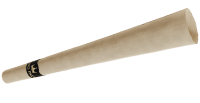
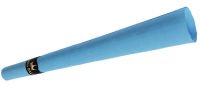
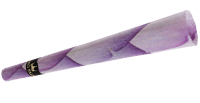
The founding of King Palm wasn't a reaction to a trend. It was a restoration of a tradition. The product that King Palm built — a natural Cordia palm leaf cone, hand-rolled, with a corn husk filter at the mouthpiece and a packing tool to fill it — is structurally identical to what the cheroot rollers of Tamil Nadu were producing centuries ago. Same leaf species. Same corn husk filter concept. Same open-ended format. Same fundamental logic: the leaf is enough. Nothing else needs to be added.
What changed was the application. King Palm took the ancient format and built it around the modern cannabis consumer — a smoker who wants the slow burn and substantial session of a blunt format without the tobacco, the nicotine, or the additives that come with cigarillo-based wraps. The pre-formed cone eliminated the rolling step entirely. The 72% humidity pack kept the leaf pliable in the pouch. The Squeeze & Pop terpene bead added on-demand flavor without altering the wrap itself. The format was ancient. The execution was new.
The green King Palm pouch became recognizable in smoke shops across the United States in a way that no natural leaf product had achieved in the modern market. Not because of a marketing innovation — but because the product itself delivers on the same qualities that made the ancient leaf roll spread across continents in the first place. It burns slowly. It tastes clean. It contains nothing artificial. It's leaves. It has always just been leaves.
The Green Palm Leaf That the World Came to Know
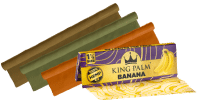
King Palm's distinctive green Cordia palm leaf is now one of the most recognized natural smoking products in the United States — and increasingly around the world. In just a few years from its 2016 founding, King Palm expanded into six sizes, over 30 flavors through the Squeeze & Pop system, and a full product ecosystem that spans rolling papers, paper cones, goji wraps, hemp wraps, storage accessories, and grinders.
But the product that started it all — the natural palm leaf roll — remains the heart of the brand because it is the product most directly connected to a tradition that stretches back at least a thousand years. When someone packs a King Palm Mini or a King Palm Slim and lights it up, they are participating in a format that Mayan communities illustrated in stone, that Tamil Nadu artisans perfected for export to the British Empire, that Conestoga wagon drivers reinvented independently on the American frontier, and that has survived — through industrial displacement and cultural forgetting — because the natural leaf is genuinely irreplaceable.
King Palm didn't create that. It just brought it back.
From Mayan leaf-wrapped cigars in the 10th century, to the ancient cheroot tradition of South Asia, to the Conestoga stogie of the American frontier, to the King Palm pouch on the smoke shop counter — the format has always been the same. Natural leaf. Hand-rolled. Nothing added. The tradition is a thousand years old. King Palm made it world-famous.
→ Shop King Palm Natural & Flavored Palm Leaf Rolls
→ Learn More About King Palm
Frequently Asked Questions
What is the history of palm leaf smoking?
Palm leaf smoking dates back at least to the 10th century, when ancient Mayan civilizations of Central America used leaf-wrapped cylinders as one of the earliest documented forms of cigar smoking. Simultaneously and independently, communities across South Asia — particularly in the Tamil Nadu region of southern India — were developing the cheroot: a cylindrical hand-rolled natural leaf with a corn husk tip at the mouthpiece. The format spread globally through the 15th century when Columbus's sailors encountered it in Central America and carried it to Europe. By the 19th century, the Indian city of Tiruchirappalli alone was exporting approximately 12 million hand-rolled cheroots per year. King Palm was founded in 2016 to bring this ancient natural leaf format back to the modern market.
What is a cheroot and how does it relate to palm leaf rolls?
A cheroot is a cylindrical hand-rolled cigar with both ends cut flat rather than tapered. The word comes from the Tamil word curuttu, meaning "roll," and the format originated in South India before spreading across South and Southeast Asia and eventually the world. Traditional cheroots were made from dried natural leaf outer wraps — including palm leaf — with a botanical fill and a corn husk tip at the mouthpiece to filter the draw. This is structurally identical to a King Palm roll: natural Cordia palm leaf, botanical fill, corn husk filter at the mouthpiece. The cheroot is the direct historical ancestor of the modern palm leaf roll.
When did the Mayan civilization smoke leaf-wrapped cigars?
Archaeological illustrations and stone carvings from Mayan civilization depict leaf-wrapped smoking dating back to at least the 10th century — making this one of the earliest recorded depictions of cigar-style smoking in human history. The Mayans used large, pliable natural leaves as wrappers for botanical fills, a format that spread globally when Columbus's sailors encountered it in Central America in the late 15th century and carried the practice back to Europe.
What is the origin of the word "cheroot"?
Cheroot traces back to the Tamil word curuttu (சுருட்டு), meaning "roll" — a direct description of the cylindrical hand-rolled leaf format. The word entered Portuguese as charuto, moved into French as cheroute, and appeared in the English language by the 1670s. The Tamil-speaking communities of South India, particularly from the city of Tiruchirappalli in Tamil Nadu, were the original producers of the cheroot format that spread across the colonial world.
What is a stogie and how does it connect to the cheroot?
A stogie is an American version of the cheroot — cylindrical, both ends cut flat, hand-rolled, no taper. The name comes from the Conestoga wagons of the early American frontier: the teamsters who drove these wagons favored this style of simple, affordable, open-ended cigar. The format was independently developed in America in the early 1800s and arrived at the same design that had been used in South Asia and the Americas for centuries — because the fundamental logic of the format is universal.
Why did King Palm choose natural palm leaf for its rolls?
King Palm was founded in 2016 specifically to restore the ancient natural leaf roll format to the modern market. The Cordia palm leaf was chosen because it is the same species that communities across South and Southeast Asia have been using for generations — its natural density produces a slower burn than any processed paper or tobacco wrap, its flavor neutrality lets the flower's terpenes come through cleanly, and its structure holds a rolled cone shape without additives or binders. The corn husk filter built into every King Palm roll traces back to the same element used in traditional cheroots for centuries. The format is ancient. The application is modern.
Is King Palm connected to the ancient cheroot tradition?
Directly. King Palm's natural palm leaf rolls use the same Cordia palm leaf, the same open-ended cone format, and the same corn husk filter tip that defined the traditional cheroot across South and Southeast Asia for centuries. King Palm was founded with the explicit intention of bringing this ancient tradition back to a market that had been dominated for decades by processed tobacco wraps and chemical additives. The palm leaf roll predates every modern smoking product on the market by at least a thousand years. King Palm made it a household name.


